About the book
Applied Wisdom: Bad News Is Good News and Other Insights That Can Help Anyone Be a Better Manager is both an autobiography and a book of pragmatic business advice. Rich in stories and practical examples, it is a management manual built from a career that began on an Indiana farm and ended running one of Silicon Valley’s great success stories.
From chapter one
I’ve had a long career, one of the longest running of a CEO at a major Silicon Valley high-tech company. I’ve managed through recessions, industry cycles, trade wars, talent shortages, you name it. I’ve advised three U.S. presidents on matters of technology and trade policy and I’ve sat on the boards of some of the most innovative and successful companies in the world, including Cisco, Genentech, and Komatsu. Applied Materials was a leader in globalization before that became a buzzword. We were among the first high-tech companies to offer customers solutions, not just products. We had a diverse workforce before that became fashionable. We invested in understanding and then cracking the technology markets in Japan and later in China when others had failed. Through it all we established a reputation as innovators and technology leaders.
None of those good things happened by relying on diving saves and make-or-break moments. They happened because we created an excellent culture of accountability where highly trained, skilled employees were supported and encouraged to speak up when they saw or heard a problem developing. Insulated leaders sometimes kid themselves that the “average employee” doesn’t know what’s going on or doesn’t get the “big picture.” In my experience, that is not the case. The key is to listen respectfully so employees feel comfortable telling you what’s going on. Then, you can form an effective partnership and build something you’re all proud of.
A note to my readers
This book is designed to help anyone who wants to learn to make better decisions, manage more effectively, and more successfully lead organizations. I talk about my personal journey, embedding in my stories a set of tips and insights that have worked for me over a long career that began in the low-tech world of farming and vegetable canning but eventually led me to manage high-tech innovation on a global scale. As my involvement in non-profit organizations increased, I realized those same tips work in the non-profit sector as well. I was motivated to share them in a way that I hope is useful to a wide audience of managers working their way up the ladder or running small organizations.
Excellent managers are not born. They develop by learning: to identify critical driving forces in their environments; to build momentum by timely decision-making; to collaborate in a transparent and ethical manner; and to implement basic structures and processes in an overall climate of respect.
The best managers help people maximize their potential. Every person, regardless of education, training, or current position, is capable of improving his or her management skills, whether in a start-up, a global company, or a non-profit rich in passion but limited in resources.
To your success,
Jim Morgan, 2016
About the authors
James C. Morgan
As a Cayuga, Indiana farm boy, Jim Morgan grew up herding cows, harvesting corn, and working in his family’s vegetable cannery. He ended up managing high-tech innovation on a global scale as he led Applied Materials to become a worldwide technology leader.
Morgan ran Applied Materials for nearly three decades, one of the longest tenures of any Fortune 500 CEO. The company was near bankruptcy when he joined; when he retired as CEO in 2003, Applied was a multi-billion dollar global leader with more than 15,000 employees.
Along the way, Jim collected and tested his management principles in such realms as the military, the diversified conglomerate Textron, in venture capital, on corporate boards and government commissions, and in the non-profit arena. He has served as both a California and a global director, and co-chair of the Asia Pacific Council of The Nature Conservancy. He and his wife, Becky, founded the Northern Sierra Partnership, which fosters collaboration among conservation organizations to preserve and restore the Northern Sierra Nevada.
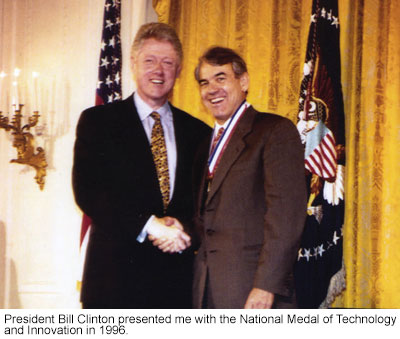
Jim also served as Vice Chair of President George W. Bush’s President’s Export Council and as an adviser to President Bill Clinton and Congress on U.S. and Pacific trade and investment policy. He holds a degree in engineering and an MBA from Cornell. He co-authored the 1991 book Cracking the Japanese Market: Strategies for Success in the New Global Economy. Among his recognitions are the National Medal of Technology and Innovation, the IEEE Robert N. Noyce Medal, and the Silicon Valley Leadership Group Lifetime Achievement award.
Joan O’C. Hamilton
Joan O’C. Hamilton is a San Francisco Bay Area writer who works with executives, elected officials and candidates, scientists, and other high-profile individuals on book projects and other positioning content. She is a former bureau chief, columnist, and correspondent for Business Week and a contributing editor at Stanford Magazine. Her work has appeared in The New York Times, Town & Country, Wired, The Boston Globe, and many other publications.